

Spring Festival Couplets, Chunlian in Chinese, is also known as Spring Couplets or Chinese New Year Couplets. The couplets are pairs of poetry lines. They the most common and important custom when celebrating Chinese New Year. This tradition is widely kept in both modern cities and rural areas of China.
With black or golden characters written on red paper, Spring Festival Couplets are vertically pasted on both sides of the front door, and a four-character horizontal scroll is affixed above the doorframe. Pasting couplets expresses people’s delight in the festival and wishes for a better life in the coming year.
The first line (left scroll) and the second line (right scroll) have parallel structures and an equal number of characters, but the meanings are antithetical although related. There must be a one-to-one correspondence between the two lines. The tone pattern is emphasized, but rhythm is not important. The horizontal scroll, the four-character phrase, sums up the two lines’ meaning. Here’s an example:
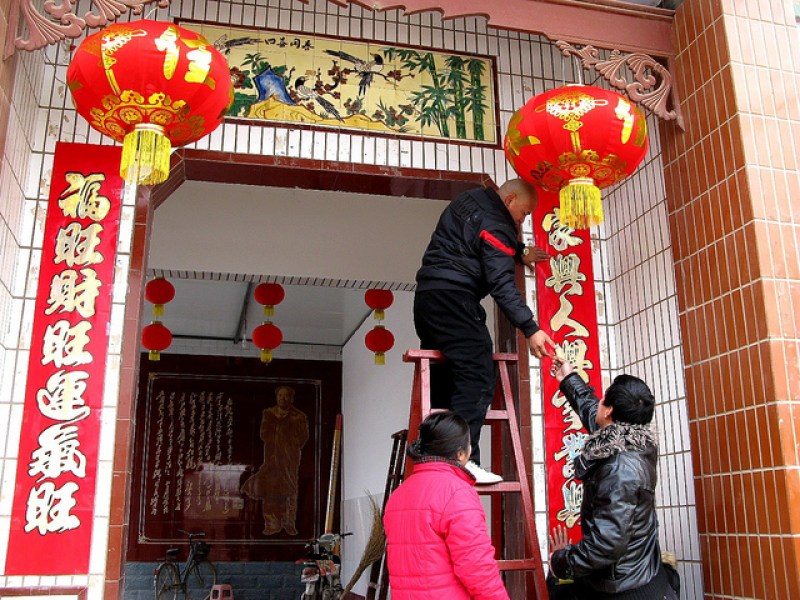
Spring Couplets originated from Taofu, an inscription on boards made from peach trees in the Zhou Dynasty (1046–256 BC). According to the legend, in the ghost world a rooster perching in a big peach tree will crow at dawn to call all the traveling ghosts back. In front of the entrance of the dark world, there are two guards named Shentu and Yulei. If the ghosts harm any people at night, the guards will kill them for the tiger’s breakfast. People believed that peach trees can scare and subdue evil things, so they hung peach boards in front of the doors with the guards’ names written or inscribed on them.
During the Song Dynasty (960–1279 AD), the wood board was replaced by paper, and people focused more on bright wishes for the future. The custom became popular in the Ming Dynasty (1368–1644 AD). When the Emperor Zhu Yuanzhang traveled for inspection, he found those pairs of scrolls interesting. In order to advocate and promote this cultural activity, he ordered all household to paste the scrolls during the Chinese New Year. This tradition continues today.
— IX
You must be logged in to post a comment.